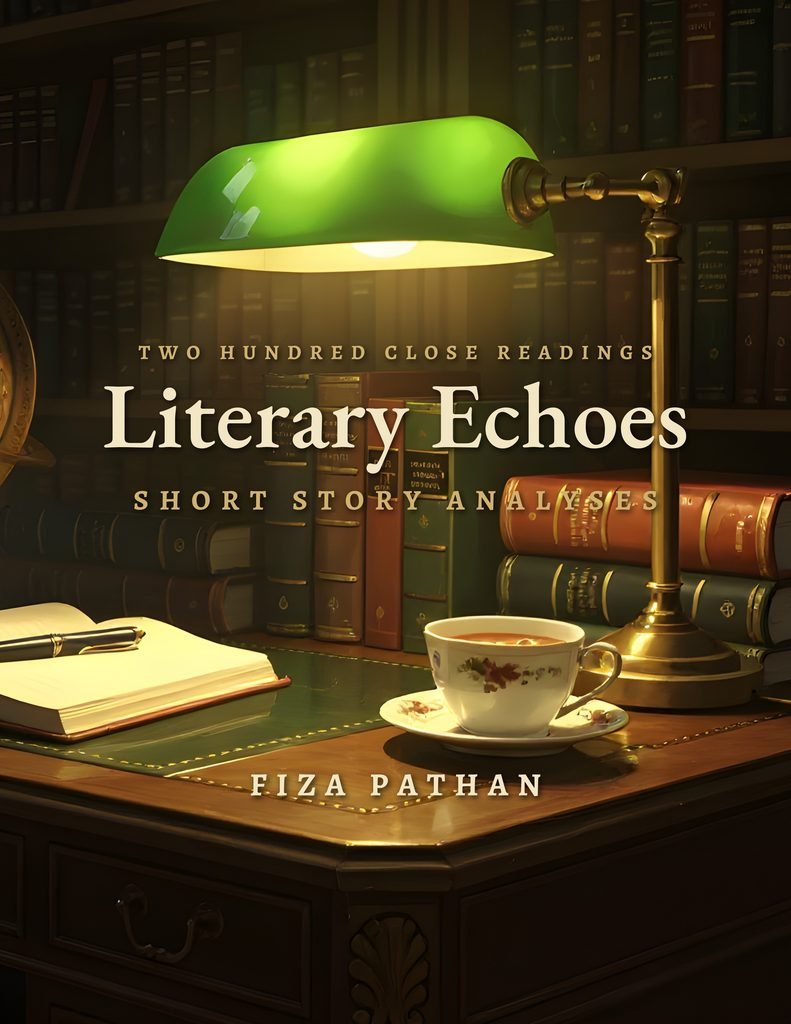
My book Literary Echoes: Short Story Analyses is now published and available through Amazon and IngramSpark and its distribution agencies. A large print edition is in preparation. It has been the longest single undertaking of my working life, and I would like to say something about what it is and why it took the shape it did.
Literary Echoes collects two hundred close analyses of short stories, running to roughly three hundred and seventy-eight thousand words. The print edition is 660 pages. It is not a book anyone will read straight through, and it wasn’t built for that. It was built to be opened at a particular story, by a particular reader, at the particular moment when she needs a second opinion.
The readers I had in view while writing were quite specific. Students preparing for board and diploma examinations, who are asked to produce an argument about a story and are rarely shown what an argument looks like when it is being assembled. Teachers who must take a class through a text they may not have chosen. And the general reader who has finished a story, felt that something was happening beneath the surface, and wanted a companion in working out what.
Each analysis is accompanied by discussion questions. Those questions were, for me, the hardest part of the book, and I am pleased that reviewers have singled them out. A question that has one correct answer teaches nothing. A question that has no answer at all teaches less. What I wanted were questions that could not be answered without returning to the text, which is the only place where the answers actually are.
The book has begun to find its readers. Readers’ Favorite awarded it five stars across all six review categories in a review by Jamie Michele that paid particular attention to the discussion questions and the close-reading method. The Midwest Book Review has called it “a masterpiece of literary criticism and analysis,” and an “unreservedly recommended pick for personal, professional, community, and college/university library American Literary Fiction Criticism and Analysis collections and supplemental Creative Writing studies lists.” It is scheduled for the September 2026 issues of Library Bookwatch and Internet Bookwatch. The Wishing Shelf review is also in hand, and calls the book “a truly wonderful resource for students, educators and the layman, helping them to understand the artistic and cultural significance of the short story. Highly recommended.” The Wishing Shelf awarded it five stars. Having serious reviewers engage with the method rather than merely the length has been the most satisfying part of publication.
For readers who require it, the large print edition will run to over a thousand pages. Producing it was not an afterthought. A book about reading closely ought to be readable by everyone who wishes to read closely, and I would have found it difficult to defend an edition that was not.
Where to buy
The Kindle, paperback, and hardcover editions are all on sale now. Ingram distributes the book worldwide, so any bookshop willing to order from Ingram can supply the print editions, and the large print edition will follow.
